Low‐Temperature Atomic Metal Deposition for an Efficient Dual‐Site Incorporated Photocatalyst
Seungwoo Yoo†, Chan Woo Lee†, Kangjae Lee†, Junseok Moon, Hyunsoo Ji, Jaeho Moon, Dongho Shin, Youngha Kweon, Juri Lee, Kang Kim, Jaewoo Lee, Guocheng Deng, Byoung-Hoon Lee, Jaeyune Ryu, Minho Kim*, Megalamane S. Bootharaju*, and Taeghwan Hyeon*
Advanced Materials, Jul 2025
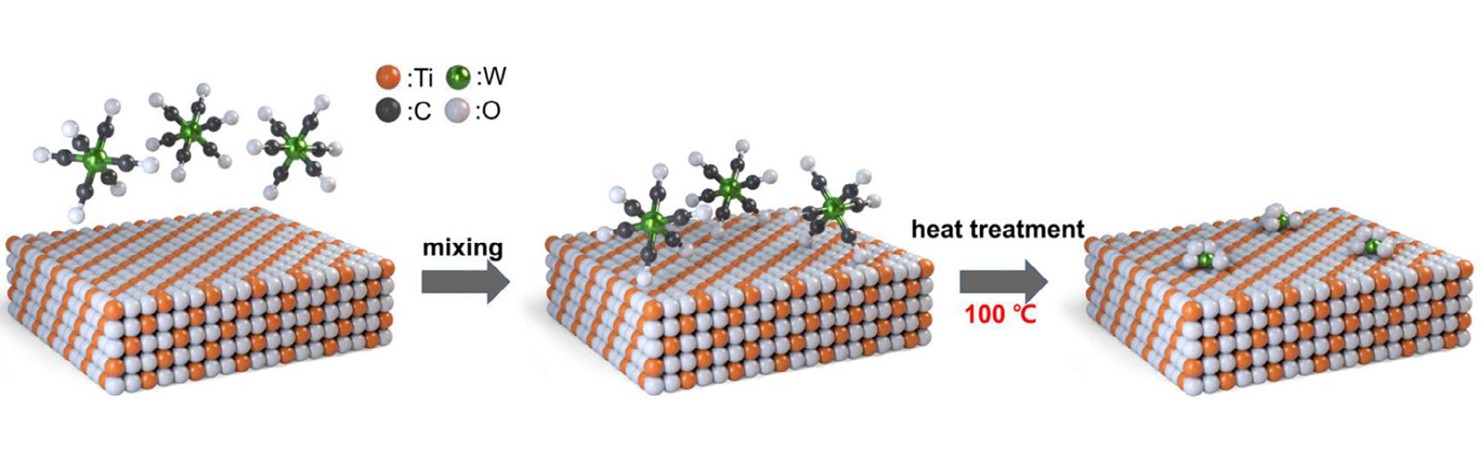
A universal, low-temperature atomic metal deposition (LTAMD) strategy is herein reported for synthesis of atomically dispersed metal catalysts (ADMCs) using metal carbonyl precursors. This scalable approach enables the fabrication of diverse ADMCs with various transition metals, including W, Cr, Mn, Fe, Co, Mo, Ru, Rh, and Re on oxide and carbon-based supports. Tungsten-incorporated TiO2 exhibits exceptional photocatalytic benzene oxidation activity, attributed to the generation of surface oxygen vacancies with Ti3+, which act as active reduction sites under aerobic conditions, facilitating the formation of reduced oxygen intermediates. It is demonstrated that tungsten plays a crucial role in stabilizing these oxygen vacancies and promoting electron-hole separation by accommodating photogenerated holes and activating the C–H bond of benzene. Leveraging dual-site photocatalysis, the tungsten-TiO2 system achieves a remarkable 42.7% yield in the photocatalytic oxidation of benzene to phenol, with high recyclability over ten cycles. By integrating theoretical insights with experimental results, a distinct photocatalytic mechanism is unveiled, driven by the synergistic interaction between atomic tungsten and TiO2. This strategy not only enables the energy-efficient synthesis of a broad range of ADMCs on various supports but also enhances the intrinsic catalytic properties of the TiO2 photocatalyst without compromising its crystal or electronic structure.